Pages

 
Showing posts with label Malign vs Benign Deflation. Show all posts

Is Deflation Still a Threat?

0 comments
Reuter's Christopher Swann says yes. He explains the nature of the current deflationary pressures and argues they still pose a threat:

The current variety of deflationary pressure... stems not from efficiency savings but rather from weak demand. Worse still, it is accompanied by record levels of debt.

Despite frantic efforts to pay off loans, household debt is still around 130 percent of disposable income. This was precisely the combination that Irving Fisher warned about in his celebrated 1933 article on debt deflation.

Under these conditions, the rising real value of debts encourages households and businesses to sell their assets to pay down loans. As fire sales reduce asset prices — stocks and property — real net worth declines further. Output and employment decline, accelerating the slide in prices.

[...]

So we are right to be afraid of deflation — very afraid. It still has the potential to sap energy from the American economy for years to come.

The Federal Reserve is preparing to lay down its unorthodox monetary policy instruments. But it may have to dig deep into its tool box before too long if deflation takes hold.

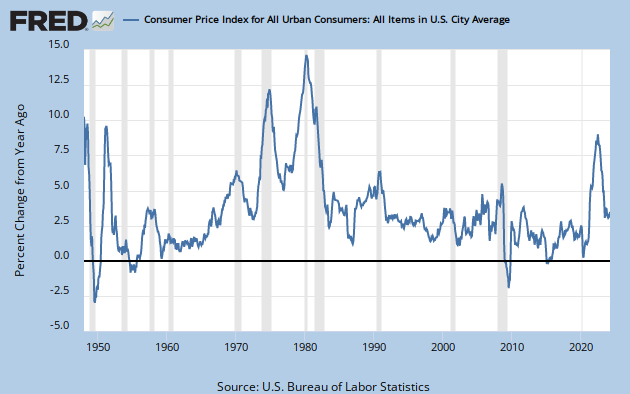
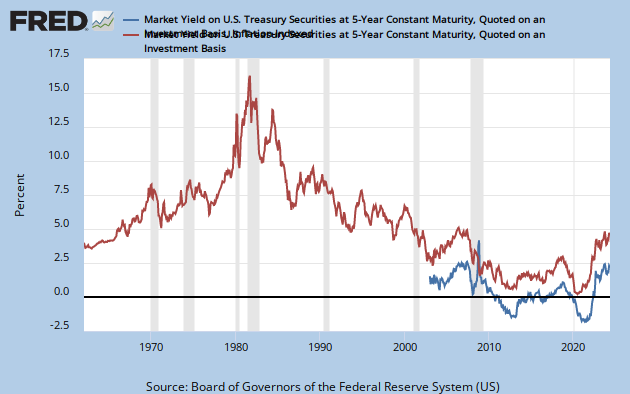
Swann cites research in the piece that core inflation is overstated by 1%. Headline CPI inflation on a year-on-year basis has been negative as can be seen in this graph. TIPs securities, however, show an expected average rate of inflation over the next 5 years that is positive at about 1.3%.

One thing I like about Swann is that he takes the time to explain why today's deflationary pressures are harmful--they are driven by a collapse in aggregate demand--and different than the more benign deflationary pressures that occurred earlier in the decade--they were driven by an increase in aggregate supply. This is the view I hold as noted here and here. Finally, note that the fundamental problem here is not deflation per say but a collapse in nominal spending. That is why we need more than ever a nominal income targeting rule.
Read more from this post in Review topics and articles of economics »

The Deflation Threat of 2009 vs. The Deflation Threat of 2003

0 comments
Over the weekend, Alan Blinder in the New York Times and Ambrose Evans-Pritchard in the Telegraph both noted that that the real threat currently facing the U.S. economy is not inflation but deflation. One only needs to look at the large negative output gap, the dramatic collapse in nominal spending, or the declines in velocity and the money multiplier to see that there is merit to their claims. There is a real deflationary threat lingering over the U.S. economy in 2009.

With that said, there is an unfortunate irony to the current deflationary threat that can be traced back to 2003. Back then there was another deflationary threat that concerned the Federal Reserve (Fed). As a result, the Fed lowered the federal funds rate to what was at the time an historically low value of 1%. It held this short-term interest rate there for a year before gradually tightening. As we now know, this excessively-loose monetary policy was an important contributor to the buildup of the economic imbalances that eventually led to this economic crisis, including the current deflationary threat. In short, the fear of deflation in 2003 laid seeds for the deflationary threat of 2009.

What makes this an unfortunate irony is that this chain of events did not have to happen. For there was a big difference between the deflationary pressures in 2003 and the ones in 2009. In 2003 the deflationary pressures were driven by rapid productivity gains and were benign in nature. Moreover, nominal spending or aggregate demand was rapidly growing. There simply was no evidence of a malign deflationary threat as there is today and thus, there was no need for the Fed to drop interest rates so low for so long. I have documented these developments in previous posts, but here are a few key graphs that make the case. First, here is the year-on-year productivity growth rate plotted against the ex-post real federal funds rate (click on figure to enlarge):


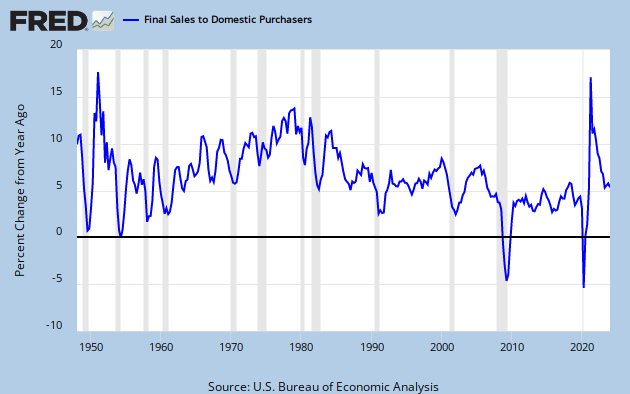
This pictures shows that Fed was pushing the real federal funds rate into negative territory just as productivity was increasing. The next figure shows final sales to domestic purchasers, a measure of nominal spending in the United States plotted against the federal funds rate. The year 2003 is marked off by the dotted lines (click on figure to enlarge):


No indication here of a collapse in nominal spending in 2003. (There was the weak labor market in 2003, but as I have argued before the slow recovery of employment can most likely be traced to (1) the robust productivity gains and (2) the inordinate substitution of capital for labor given the low interest rates of the time.) What this all means is that the Fed's misreading of the deflationary pressures in 2003 contributed to the creation of deflationary pressures of 2009.

My hope is is that moving forward the Fed and other monetary authorities will be more careful in assessing the sources of and responding to the deflationary pressures.
Read more from this post in Review topics and articles of economics »

Understanding Recent Economic History

0 comments
The Economist magazine has an article on what it sees as the beginning of a new global economic order. In the article, the history of international monetary systems up through the present economic crisis is reviewed. Here is an excerpt from this history that I particularly liked:
The post-Bretton Woods system worked well, engendering the long period of low inflation and steady growth known as the Great Moderation. But one of the reasons for its apparent success—the growth of India and China—may have sparked its demise. The addition of these two great nations to the international financial system was a supply shock that put downward pressure on inflation rates.

As Stephen King, an economist at HSBC, has pointed out, the result might have been a benign deflation that boosted Western living standards. But central banks struggled to avoid a deflationary outcome; the result was a loose monetary policy that encouraged asset bubbles. Those bubbles lasted longer than expected because the flood of savings from developing markets held down the risk-free rate.
This is spot-on analysis by The Economist. I make a similar argument in this recent article in the Cato Journal.
Read more from this post in Review topics and articles of economics »
 
Review topics and articles of economics © 2011 Malign vs Benign Deflation